About Versapass™
Virtually all material processing industries e.g.; chemical, petroleum, power, pharmaceutical, food and beverage, semiconductor, and R&D laboratories require thermal or other types of monitoring, sampling, and/or fluid additions for proper manufacturing and process development. These activities are typically accomplished by inserting a cylindrical probe or dip tube into a process stream or reactor vessel.
In pharmaceutical research or process applications, probes or dip tubes are often manufactured to a specific length and sealed in place to a sanitary fitting to avoid entrapment areas that can contaminate the process fluid. Contamination from residual fluid or microbial growth is very costly in this industry, whether the application is for research and development or production. Although a one-piece design can be clean, it does not allow for variable insertion of the probe or dip tube once it has been manufactured. In addition, custom dip tubes, thermocouples, and probes are somewhat expensive and have long lead times.
Variable insertion of a probe or dip tube is desirable in certain applications to locate the optimal sensing, sampling, or addition point in a process stream or reactor. Examples include reactors with non-homogenous, stratified fluids or thermal points, reactors with changing fluid levels, and process systems that require retractable probes or dip tubes.
For industrial applications, engineers and technicians would typically incorporate an industrial feed-through or a bored-through Swagelok fitting with Teflon ferrules.
For pharmaceutical and other high-purity applications, both industrial feed-through and bored-through Swagelok fittings have been welded, threaded or modified to fit sanitary fittings. As a tube fitting, Swagelok components are best in class. But as a feed-through fitting for pharmaceutical and high-purity applications, it is suboptimal to use them as well as modified industrial feed-through fittings. From a cleanliness standpoint, these fittings have significant dead volume for entrapment. Although there are numerous fluid handling devices such as diaphragm valves, ISO 2852 sanitary fittings, pumps, and hoses designed for minimal entrapment and cleanliness, no such device exists to accommodate the insertion of a probe or dip tube in a manner that is clean and variable.
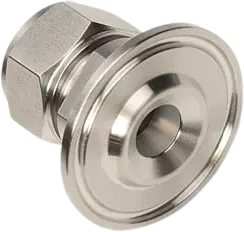
Many customer requests to find an alternative to using industrial feed-through fittings in a sanitary process were answered by the creation of the Versapass™ fitting. Versapass™ product objectives include a clean design, inert materials of construction, pressure, vacuum, and thermal cycling capability. The zero dead volume design makes Versapass an ideal choice for semiconductor and vacuum feed-through applications, too.
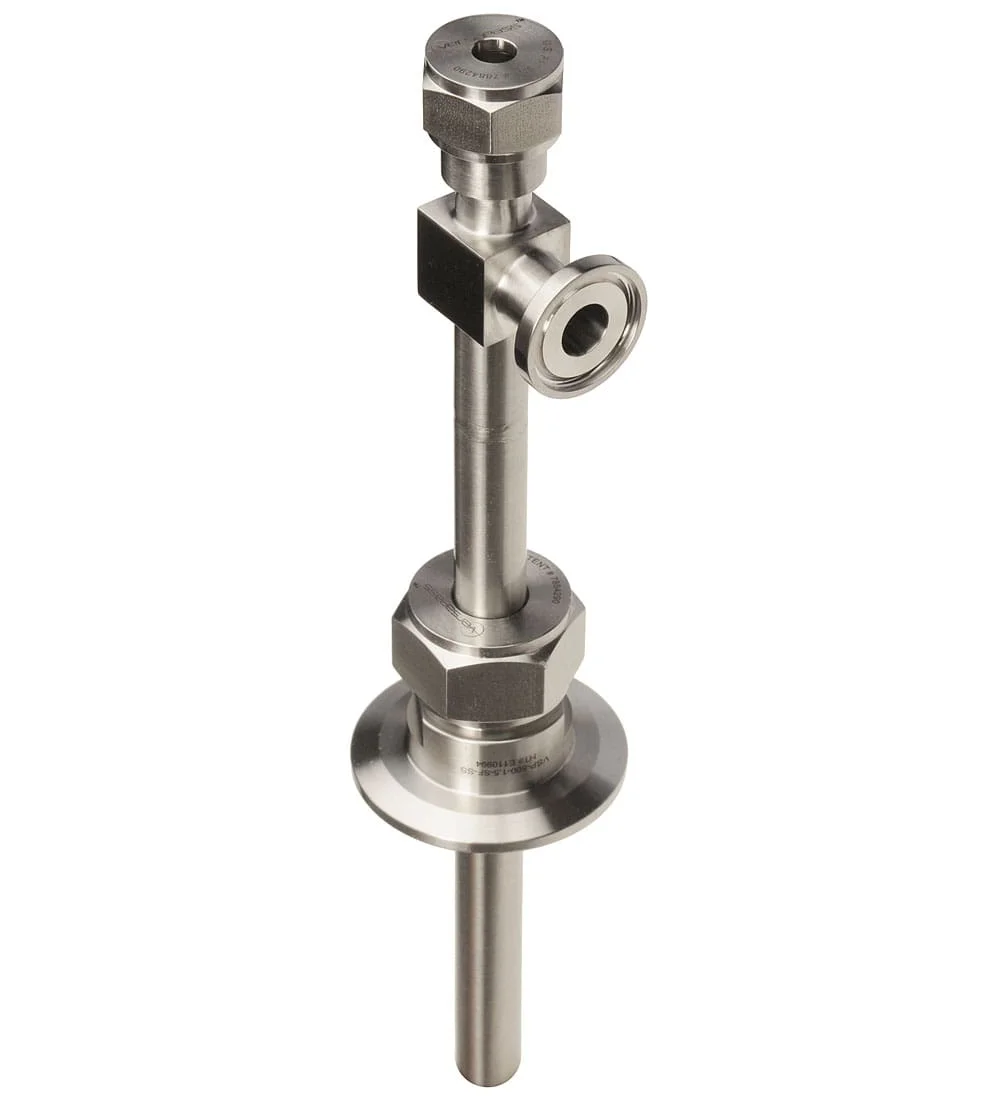
The Versapass™ design accomplishes variable clean insertion (VCI) by a unique geometry that seals the probe or dip tube at its point of immersion with a fully swept flow path into the process fluid. Versapass™ does not deform, swage, or damage the probe or dip tube for repetitive use. One sanitary feed-through fitting can accommodate any cylindrical device to a calibrated insertion depth without entrapment or dead volume.
Through a Common Port, Any of the Following Devices Can Be Used:
Versapass™ is a unique product enabling field instrumentation and process control for a wide range of sanitary, vacuum, and ultrapure applications. It is ideal for pilot labs and reactor vessels. Because of its universal design, it is ideal for cGMP scale-up operations where maximum cleanability and mechanical versatility are critical for developing processes.